What is iridology? A plain-language introduction
Iridology is a complementary practice in which a practitioner studies the patterns, colours and markings of the iris, the coloured ring of your eye, and relates them to a map of the body. It has a long history and a loyal following. It also has a clear research record, which we cover honestly below.
Where iridology came from
People have looked to the eyes for clues about wellbeing for centuries, but iridology as a system is fairly modern.[1]
- 1665: Philippus Meyeus described ideas about the iris and the body in Chiromatica Medica, one of the earliest written references.
- 19th century: Hungarian physician Ignaz von Peczely is usually called the founder of modern iridology. A popular story says he noticed a mark in an owl's eye after it broke its leg. Even his own nephew later questioned that story.
- 1893: Swedish practitioner Nils Liljequist published an atlas of iris drawings that helped spread the practice in Europe.
- 1950s onward: American practitioner Bernard Jensen developed a detailed iris chart and taught it widely. Versions of his chart are still in use today.
How practitioners describe it
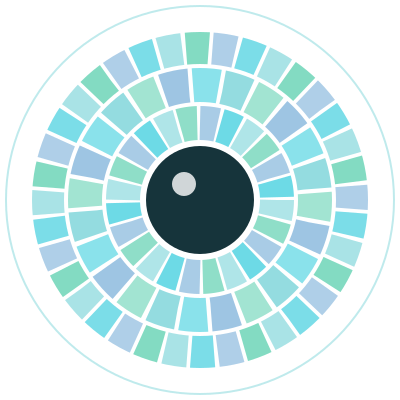
Iridologists use an iris chart that divides each iris into zones, a bit like the face of a clock. Each zone is linked to a part of the body, and the right and left eyes are read separately. Practitioners look at features such as:
- Colour and density of the iris fibres
- Rings and arcs, including the ring around the pupil sometimes called the "collarette"
- Spots, flecks and lines in particular zones
In practice, a session usually combines iris observation with a conversation about lifestyle, sleep, diet and stress. Many people value that conversation as much as the reading itself.
What the iris actually is
Biologically, the iris is a thin ring of muscle and connective tissue that controls how much light enters the eye by changing the size of the pupil. Its detailed texture forms before birth and stays remarkably stable through life. That stability is why iris patterns work so well for biometric identification, the iris scanners used at some airports and banks.[2] It is also one reason scientists are sceptical that iris patterns change in step with health elsewhere in the body.
What the research says
Iridology has been tested in several controlled studies over the past 45 years. In those studies, iridologists looked at iris images without knowing who was healthy and who had a confirmed condition. Overall, their accuracy was close to chance (about 50%). A 2024 evidence evaluation commissioned by the Australian Government reviewed the best available studies and concluded that manual iridology "was not a reliable or accurate diagnostic technique".[3]
How to approach iridology sensibly
- Use it for reflection, not diagnosis. A reading or wellness report can be a useful nudge to think about sleep, food, movement and stress.
- Never delay medical care. If you have symptoms, see a doctor, whatever an iris reading suggests.
- Keep up regular eye checks. An optometrist can check your vision and eye health, which iridology does not do.
- Be wary of big claims. Be cautious of anyone who says an iris reading can find or rule out a serious illness.
Where hai fits in
hai builds two tools inspired by the iridology tradition, and we design both for general wellness and education. The HAI App gives you a simple wellness check-in from two eye photos and a short questionnaire. HAI BOSS helps practitioners and wellness centres run their practice digitally. Neither is a medical device, and neither replaces your doctor.
Frequently asked questions
Is iridology the same as an eye exam?
No. An eye exam by an optometrist or ophthalmologist checks your vision and the health of your eyes using clinical tests. Iridology is a complementary practice that looks at iris patterns and does not assess eye health or vision.
Can iridology diagnose illness?
Controlled studies have found that iridology cannot reliably identify specific health conditions. It should not be used to diagnose illness or to decide whether to see a doctor.
Where is iridology practised?
Iridology is practised in many countries, including Malaysia, Singapore, Australia, Germany and the United States, usually alongside other complementary and wellness approaches.
Sources
- "Iridology." Wikipedia, accessed 16 November 2026 (history section; see its primary references). Link
- Daugman J. How iris recognition works. IEEE Transactions on Circuits and Systems for Video Technology. 2004;14(1):21–30. Link
- Australian Government Department of Health and Aged Care. Natural Therapies Review 2024: Iridology evidence evaluation. Published March 2025. Link

Last reviewed 16 Nov 2026. We update our articles when new research is published. Spotted an error? Email admin@haihealth.ai.